| The History of Caps Lock: Why Does the Caps Lock Key Exist? |

|

| Monthly Highlights, August 2020 |
| In the past month, as organizations continue to grapple with ongoing disruption brought on by the pandemic, many are also looking to the future and the great reset. Below is a selection of our top reads on the crisis and what lies ahead; explore our full collection, The Next Normal: Beyond the coronavirus crisis, for even more.
|


Courtesy of UNC-Pembroke
There's no standard plan for how colleges should handle the coronavirus pandemic. There's not even a uniform plan for how states should deal with the virus — but that's a another story.
This one is about how two campuses are planning the fall semester amid the virus.
In June, when cases were rising in North Carolina, the University of North Carolina at Pembroke held a virtual town hall. Robin G. Cummings, the chancellor, was clear when faculty members asked him why the university was planning for an in-person fall under those conditions.
“The short answer is that this is a decision that we as a system made some time back," Cummings said. The chancellor, a medical doctor who once served as acting state health director, said he feared that if the campus had a virtual fall semester, some students would take a gap year. A significant part of the university's revenue comes from tuition, so to "some degree" the decision was financial, he said.
Beyond the financial worries, Pembroke must deal with other risks. The university is located in Robeson County, which has seen North Carolina's highest rate of coronavirus infections lately. Robeson and surrounding counties are home to the Lumbee Tribe (of which Cummings and his wife are members). And 42 percent of Robeson County residents identify as American Indian and 24 percent as Black, two demographic groups that have been found the most likely to die of Covid-19.
Still, this week students started moving into dorms filled to their usual capacity. The university doesn't plan universal testing for the virus. And because of limited space, Pembroke will encourage students who test positive to return to their family homes.
Meantime, 400 miles to the north, the Johns Hopkins University made an announcement on Thursday that was nearly the opposite. Hopkins reversed its pledge to bring undergraduates back to campus for in-person classes, housing, and activities, and it urged students to stay away from Baltimore for the fall semester. Employees were told that they should expect to work from home through the year.
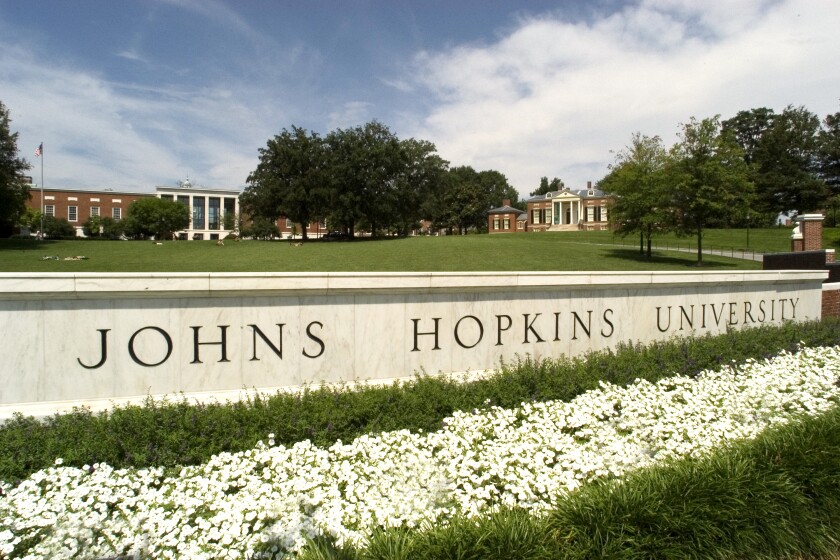
Courtesy of Johns Hopkins U.
Hopkins has so many factors going for it: a large endowment, breakthrough research on the virus, a key virus tracker, and close ties to world-renowned medical services. But even one of the country's heaviest-hitting research universities had its plans stymied by Covid-19.
However, Pembroke and Hopkins aren't complete polar opposites. And where those two institutions overlap, yours may too. Both universities are under serious financial strain. Hopkins said it expected a $475-million
net loss through June 2021, largely blamed on the loss of revenue from physician clinical services. Hopkins will also reduce undergraduate tuition by 10 percent this fall. In June, Cummings told Pembroke administrators that the university faced a 10-percent budget cut from state appropriations.
What differentiates Pembroke and Hopkins allowed the institutions to make contrasting fall plans. What they have in common — financial strain — raises the stakes that their plans must work.
Read our Francie Diep's story on Pembroke and our Lindsay Ellis's story on Hopkins.
|
|
| Today’s Tip |
| Use Your Social Network to Promote Equity and Inclusion |
| If you're looking for ways to actively champion women and people of color, consider using a powerful tool you already have: your social network. There are two simple ways you can use your network to be a better ally and promote equity in your workplace. First, show your support by broadcasting anti-racist, anti-sexist values. Research has shown that when you post on social media, you're reaching much farther than your immediate contacts. Little by little, you can help to create a new norm when your friends and colleagues see that you believe in and live those values. Second, empower and back up women and people of color by actively including them in your network. Introduce them to people who they might otherwise find difficult to meet, or proactively forward opportunities that they might otherwise miss. It’s important to use your privilege to promote equity. And your social network can be effectively deployed in your anti-racism and anti-sexism efforts. |
| This tip is adapted from “Use Your Social Network as a Tool for Social Justice,” by Raina Brands and Aneeta Rattan |
Are you prepared for digital transformation? Learn what changes need to occur around business processes and technology, how to approach new cloud-based tools and technology, and how organizations can leverage these changes to gain a true advantage. Download report now » |

Many patients suffering from COVID-19 exhibit neurological symptoms, from loss of smell to delirium to a higher risk of stroke. Down the road, will COVID-19 survivors face a wave of cognitive issues?
There are a variety of ways job seekers could use artificial intelligence to give them an edge in a very tough environment.

| Today’s Tip |
| Write a Better Job Description |
| One of the ways that organizations miss an opportunity to attract top talent is by writing — or even recycling — lackluster job descriptions. Your goal is to attract and invite people to join your company, so the words you use matter. Don’t overinflate the qualifications for the role: You may end up discouraging good candidates from applying. Avoid language that may seem normative or limiting to women or candidates of color. For example, research tells us that women are more hesitant to apply when descriptions include more typically masculine characteristics, such as “outspoken,” “competitive,” and “ninja.” To check your unconscious bias, read your job description through a different lens. If you’re white, how might the job description read for a person of color? If you’re a driven, career person, would what you’ve written invite an applicant who needs to work from home? Consider testing the job description with a diverse group of colleagues before you post it. This may reveal any blind spots. Finally, use language that reflects and promotes your corporate values. People want to feel energized and passionate about what they do, so show them that the job offers an opportunity to contribute to your company’s collective mission. Rather than focusing on specific skills, you can use words like “high-performance creativity” and “optimistic” to describe the kind of candidates you want to apply. Hiring an individual whose values align with your organization is a win-win. It’s worth taking the time to craft a job description to invite those candidates to apply. |
| This tip is adapted from “Write a Job Description That Attracts the Right Candidate,” by Whitney Johnson |
 RIED. Revista Iberoamericana de la Educación Digital: ift.tt/1FUfKIV&&&&&&&&&&&&&&&&&&&&&&&&&&&&&&&&&&&&&&&&&&
Our reactions to the coronavirus pandemic will likely determine the future of our business for years to come. For majority of companies across the globe, the pivot to remote work has been as sharp as the learning curve many L&D professionals and HR leaders are feeling. Join us on 12th August 2020 at 4 PM IST to discuss: | |||
|

|








 BLOGCUED